

For those of you who may not know or haven’t followed Seriously Fast Motorsports for some time, as much as I’d love it to be, motorsports is not my full-time job. I founded this brand in 2020 out of boredom during the COVID lockdowns. I’m a car salesman. I’ve been everything at a dealership outside of finance; I’ve been a porter, and I’ve been a manager. In the industry, I’ve worked in retail, business development, and marketing. In fact, outside of a few months one summer, I’ve never worked outside the automotive or motorsports industries. So, I know a little about “win on Sunday,” and I know a bit about “sell on Monday.”
Win on Sunday, Sell on Monday was a simple concept. If you win races in motorsports, fans will see that, and want to buy those cars.
Although I was born in the early ’90s, I remember the ads and the stories from back in the day. “Win on Sunday, Sell on Monday.” Hell, some brands even had special editions of their production cars to tie into motorsports. Many racing brands had “Indy 500 Pace Car” editions. Remember Chevrolet’s 2001 & 2002 “Intimidator SS” Monte Carlo & Camaro? They offered Dale Jr, Jeff Gordon, and Tony Stewart Editions as well. Ford even sold a NASCAR Edition F-150 in 1998.
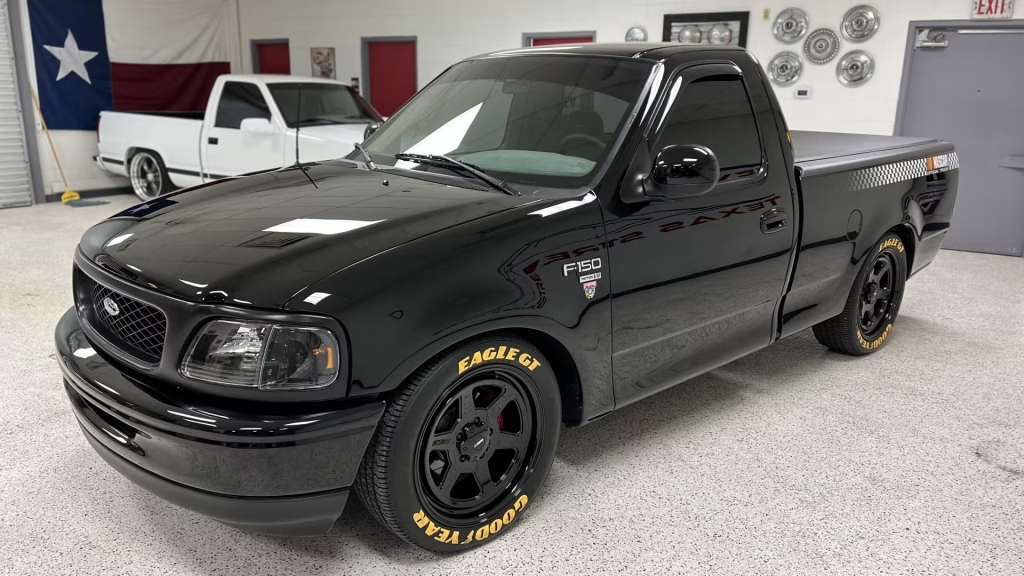
Well, in 2024, those special editions are gone. No one is making motorsport-themed production cars for the masses. On the other end of the spectrum, Aston Martin does. The English sports car icon does build a Vantage F1 Edition, but those prices START over $165,000. In the ’50s and ’60s, Enzo Ferrari quite literally only sold road cars to fund his racing teams. However, when most think of that term about selling on Monday, they think of NASCAR.
As a salesman who has been selling for the most part since 2013, I’ve sold many, many hundreds upon hundreds of cars. I’ve had people ask for some super-specific vehicles. I have never once had someone ask me for a car like the one they saw on the race track. A movie? Yes. Race track? Not once.
With NASCAR’s Cup cars being the closest to production cars they’ve been since the late 1980s, you’d think that it might promote some sort of cross-attention. But I’ve never once had someone ask me for the type of car that Joey Logano won his championship in; I’ve never had anyone ask what sort of car they run in IMSA, which is more similar to the road car.
The Marketing
One reason for this is the lack of push from the OEMs in NASCAR to compare those on track to what you can buy at the dealership and the pure lack of promotion at the dealership. I sold Toyota for several years, and we celebrated Kyle Busch’s 2015 Championship with banners and hood covers. However, haven’t seen anything of that sort since. I have sold Ford for the last couple of years until this summer. Not one banner promoting back-to-back 2022 and 2023 Championships or the Championship sweep of 2023. Nothing. The OEM’s dealership marketing departments do not care about the link between “Win on Sunday, Sell on Monday.”
Now, it’s not the individual dealer’s marketing that is failing us motorsports fans who may very well be interested in those vehicles. It is all on the OEMs. I always express my love for motorsports at my desk. I have Diecast, I have photos at the track. My screensaver is always some sort of racing. I once worked for a dealer owner who sponsored short-track racing and had racing plastered all over his office. However, the OEM’s marketing material never had a race car anywhere on it.
The Biggest Problem
Marketing is huge. Yes. No debate. However, an even more critical issue is at play here—the buyers. You and I. Look at the cars represented in NASCAR’s Cup Series: Camaro by Chevrolet (2 years discontinued), Ford’s 2-door Mustang, and the Toyota Camry. All three are legendary in their own right. People only buy one of these in any sort of significance in the United States.
- In 2023, its final production year, the Chevrolet Camaro sold just over 31,000 units, its best sales year since 2019, when it sold almost 17,000 more units.
- In the same year, 2023, the Toyota Camry sold just over 290,000 units. Almost 10x as many as the Camaro. In 2024, that number increased to just under 310,000 units.
- The Ford Mustang, the last of the American Muscle cars, sold 53,159 units. But in 2024, the pony car sold 44,000 units, the lowest sales figures in the car’s history. In fact, it was passed by its 5-door EV counterpart, the Mustang Mach-E.
People do not buy 2-door cars anymore. A prime example is over at Dodge, a brand rich in motorsports history. The Charger and Challenger are basically the same car, one with 2-doors, one with four. In their final full-production year of 2023, the 4-door Charger outsold the 2-door Challenger by 76,000 units to 45,000 units.
Look at other 2-door offerings in the US market, 2-door Nissan Altima, Gone. 2-door Honda Accord, done. Honda Civic 2-door, take a guess. Audi’s gorgeous A5/S5 is now only available in a 4-door “Sportback”. Chevrolet Camaro, kaput. Even automakers such as Ferrari, Lamborgini, and Porsche have gone 4-door with either an SUV or car because that’s what people buy.
Me personally? In the last three years I sold Ford, and I sold a whopping 4 Ford Mustang 2-doors. That includes both new retail and leases as well as pre-owned. Looking through my records, I sold 22 Escape SUVs to every 2-door car that I sold. As much as people idolize and look at cars like the Mustang or Camaro, they have families. They have limited incomes to afford a fun little sports car on top of the type of vehicles that they can live their day-to-day lives in.
To answer the title question, Does Win on Sunday, Sell on Monday” still work? The answer, sadly, is no.
How Can Win on Sunday, Sell on Monday Be Fixed?
As someone who works in both Motorsports and Automotive, I’ve seen both ends of the topic. These OEMs spend millions of dollars to have or support these racing teams. Why not spend a little bit more to promote them to the masses? It would be a win-win. You promote your racing entries while also encouraging targeted specific marketing.
In 2023, Ford Motor Company invited me to the Bred to Race event at the Detroit Auto Show. It was a spectacular showcase of Ford’s racing prowess with the Mustang and showcased the late Mustang race vehicles alongside the then-all-new Mustang road cars and the all-new Mustang GTD. When I arrived at work the following week, there were no promotions outside of myself and another sales guy who was also invited to the event. Ford let that marketing die at the show. Why? Why let something that could have become such a potentially iconic marketing tool die like that?
These OEMs once again need to develop special edition vehicles, if they promote them, and promote the racing. If a Camry wins the 2025 Daytona 500, give us marketing materials and get your dealers a “Daytona 500 edition” Camry. Mustang wins? Same thing. You now draw people to look at the car and the sport. It bridges that massive gap that currently exists. Hell, we will take posters at this point. Back in the day, the promotion materials were everywhere. Dealers even got dealer-exclusive diecasts not only to show off but also to sell in their parts departments.
Race fan-targeted marketing. When was the last time you saw a car commercial that you felt was targeted at you being a race fan? I pay attention. I have to go back many years, and I still cannot think of one. Toyota’s 2008 Fan Controler commercial is the closest thing I can think of. Correct me if I’m wrong, please. Promote a truck tailgating at a track, a car like the ones on the track, anything. Target me, the fan.
Doing it Right
One dealership that does a spectacular job promoting themselves and racing is relatively local to me—Monroe Dodge Chrysler Jeep Ram Superstore in Monroe, Michigan. The CDJR “Superstore,” as they refer to themselves, promotes racing in a unique way. The family-owned Michigan dealership supplies the Official Pace Car for the ARCA Menards Series as a Dodge Charger R/T. They do this as a franchise store not represented in the sport, and they do so without OEM support.

Header image: Photo by Jared C. Tilton/Getty Images
